How to Find the Right Therapist in India in 2026A guide from a therapist who has been on both sides of the room
I have been a psychotherapist for over 20 years and a trainer and supervisor for over 10. I hold the designation of Teaching and Supervising Transactional Analyst in Psychotherapy (TSTA-P) from the ITAA, and my work spans Transactional Analysis, Gestalt, Hypnotherapy, Psychodrama, and Creative Movement. I have trained hundreds of therapists across India and internationally, and before any of that, I was someone sitting on the other side of the room.
I didn't start out as a therapist. I started out as someone who needed one.
There was a period in my life where things weren't working, not in a dramatic, crisis kind of way, but in that quiet, persistent way where you know something needs to shift and you don't quite know what. I found a therapist. And through that process, through being on that side of the room, I understood something about what healing actually feels like when it's working. That experience is what eventually brought me to this work.
So when I write about finding a therapist, I am not writing from a textbook. I am writing from both chairs. And after two decades of sitting in one of them professionally, here is what I know to be true.
Finding the right therapist in India is less about finding the most qualified one and more about finding the right fit. The three things that matter most are whether your therapist is in clinical supervision, whether they have done their own personal therapy, and whether you feel safe, seen, and understood in the room with them. Start with a platform that screens for these criteria, or ask someone you trust for a referral. And know this: you don't need a diagnosis or a crisis to begin. A desire to understand yourself better is reason enough.
You Don't Need a Reason to Start Therapy
The first thing I want to say, before we talk about platforms or approaches or anything practical, is this: you do not need to have a good enough reason to seek therapy. I see people wait. They wait until things are bad enough, until they can justify it to themselves or to someone else, until there's a clear diagnosis or a definable crisis. And most of the time, that waiting is unnecessary.
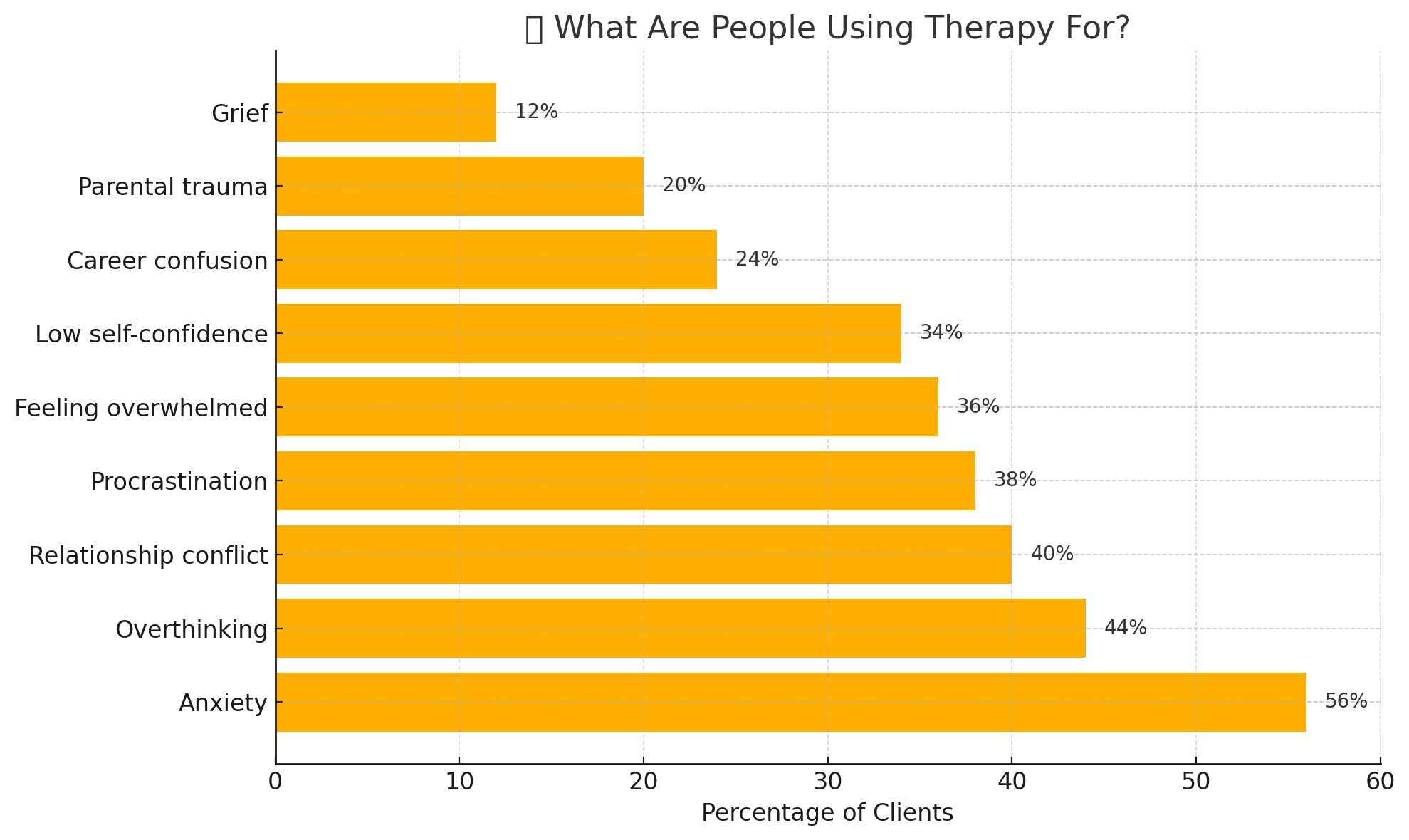
A therapy platform recently shared data from their own clients, real numbers on,"What are people using therapy for?" Anxiety topped the list, yes, at 56%. But what followed was more telling: overthinking, relationship conflict, procrastination, feeling overwhelmed, low self-confidence, career confusion. Not crises. Not diagnoses. Just the weight of ordinary life, quietly accumulating. The data shows that the people already in therapy are not necessarily the ones struggling the most. They are simply the ones who didn't wait for things to get worse before they reached out.
In my experience too, people often come to therapy for one of three reasons, and all three are equally valid.
The first is specific distress. Something is clearly not working. You can't sleep. Your anxiety won't settle no matter what you try. You find yourself reacting in ways that don't make sense to you, throwing things, shutting down, crying without knowing why. You're not functioning the way you want to in your relationships, your work, your daily life. This is the most recognisable reason, and if this is you, please don't wait any longer.
The second is general confusion. Nothing is dramatically wrong, but nothing feels quite right either. You don't know which direction to take your life. You're overwhelmed by choices like career, relationships, identity and the world keeps offering you more options and less clarity. This is especially true for our current time. We are living through a pace of change that our parents simply weren't equipped to prepare us for. Globalisation, digital overload, the constant noise of multiple lifestyles and multiple possibilities. Our brains are overstimulated and under grounded. That confusion is real, and it deserves support.
The third reason is growth. This is the one people are most embarrassed to say out loud: I don't know. I just feel like I need something. I want to grow as a person.
That is enough. That has always been enough.
Growth is the reason I find it most quietly powerful. There is no crisis. No specific problem with a name. Just a felt sense that there is more, more clarity, more aliveness, more of themselves available to them than what they're currently living. Growth oriented therapy is exploratory in the best sense. Both the therapist and the client bring their histories, their curiosity, their questions. You think together, talk together, sit with things together. And slowly, sometimes surprisingly, new parts of you begin to emerge, parts you didn't know were waiting. No goal is set at the beginning because the discovery itself is the point. Some of my most meaningful work has happened in this space. It doesn't announce itself as transformation. It just quietly becomes one.
Where to Find A Therapist in India
Once you've decided to try and I hope something in the section above has made that decision a little easier, the next question is where. There are two main ways people find therapists: through platforms, and through personal referrals.
Platforms are often a good starting point, particularly if you're new to therapy and don't know what you're looking for. The best platforms do something important before you ever arrive, they screen their therapists. They look for practitioners who are properly trained, who are registered with ethical regulatory bodies, and crucially, who are in clinical supervision and have done their own personal therapy. These things matter enormously, and I'll explain why in the next section. A platform that has already done this vetting gives you a meaningful head start. One such platform I know of is Mindbun, they don't just list therapists, they carefully vet them for training, ethics, and personal work, and then match you to someone based on what concerns you're actually coming with.
Alongside they have a range of therapists across different approaches and different specialisations, which is useful precisely because you may not yet know what kind of help you need. Having options in one place, with some structure around how you're matched to the right therapist, makes the beginning of this process less overwhelming.
Further if you'd like to explore other platforms beyond this, Shradha Chandrasekar, a NIMHANS-trained Clinical Psychologist, has written a detailed guide listing some excellent options, you can read it here.
Personal referrals, like a friend telling you about their therapist, can also lead you somewhere good. But I want to be honest about something here: a therapist who was exactly right for your friend may not be right for you, and that doesn't mean the therapist is bad or that you're difficult.
Therapists are human beings with their own histories, their own sensibilities, their own ways of connecting. Sometimes a therapist's story and your story meet in a way that is deeply useful. Sometimes they don't. Neither outcome is a verdict on anyone. If you do go this route, it's still worth asking the same questions you'd ask anywhere else, is this therapist in supervision, have they done their own personal therapy, and do they work within a regulated modality? A warm referral is a starting point, not a substitute for doing a little due diligence. The right therapist for you exists. A recommendation from someone you trust is one reasonable way to begin looking for them.
The point is: start somewhere. The perfect starting point doesn't exist, but starting does.
Directories. If you're looking for a therapist trained in a specific modality, whether that's a TA therapist in India, a somatic experiencing practitioner, or an IFS therapist, visiting the official directories of their governing bodies is one of the most reliable ways to find someone properly credentialled.
These directories list only registered, trained practitioners who are bound by the ethical codes of their respective bodies, which is a level of assurance that a general Google search simply cannot give you. The SAATA website lists Transactional Analysis practitioners across India and internationally. The IFS Institute has a searchable directory of trained Internal Family Systems therapists. And the SEI website covers Somatic Experiencing practitioners globally.
If you already have a sense of the approach you're looking for, these are worth bookmarking.
What to Expect on Cost of Therapy Sessions
Therapy in India varies widely in price, and understanding what drives that variation can help you make a more informed decision. A therapist who is actively investing in their own clinical supervision and personal therapy, which in practice means spending anywhere from INR 20,000 to 40,000 a month on their own professional development, will typically charge between INR 2,000 and INR 5,000 per session, depending on their experience, specialisation, and years of practice. That cost is not incidental. It reflects a standard of care that is globally recognised but still not widely practised in India, and it is worth knowing what you are paying for.
If that range feels out of reach, most therapists also offer a sliding scale, reduced fees for students or those who cannot afford the full rate. It is always worth asking. Most practitioners will not advertise this openly, but they will accommodate it if you raise it directly.
Before you commit to any therapist, most will offer a short introductory call of 10 to 15 minutes at no cost. Use it. This is your opportunity to ask the two questions that matter most when choosing a therapist in India or anywhere else:
Are you currently in clinical supervision? Are you currently in personal therapy?
These two questions are the clearest signal of a therapist's commitment to their own professional growth and, by extension, to the quality of care they bring to their clients. A yes to both is not a guarantee of the right fit, but it is a strong foundation to build from.
Therapy Approaches Explained: CBT, Transactional Analysis, Somatic, and More
If you've looked at any therapy platform or done any searching online, you've probably encountered a bewildering number of terms. CBT. TA. Somatic therapy. Psychoanalytic. Psychodynamic. EMDR. It can feel like you need a degree just to make an appointment.
You don't. Let me simplify it.
There are broad areas of therapeutic work, and approaches often fall somewhere within them.
Relational and historical work. This is where Transactional Analysis, psychoanalytic approaches, and psychodynamic therapy live. The core idea here is that the patterns in our current relationships, how we connect, how we conflict, how we repair, are shaped by our earlier ones. When a therapist and a client work together relationally, two histories enter the room. The therapist's and the client's. And what happens between them becomes a kind of map for understanding what has happened in all your relationships before. Transactional Analysis in particular works across thinking, feeling, behaviour, and the body together, it's one of the more integrative approaches available. Relational work is often slower, often deeper, and for many people it's the most transformative.
Best suited for: people who notice patterns repeating in their relationships, or who sense that their past is shaping their present in ways they want to understand.
Body-based work. This area is less talked about but deeply important. The body holds a great deal that the mind hasn't processed, tension in the muscles, affect stored in the nervous system, sensations that have no words yet. Somatic experiencing, muscle work, and other body-based approaches work with this directly. They track what's happening physically, help you name it, and allow you to process it through the body rather than around it. If you feel like talking hasn't been enough, or if your distress lives somewhere physical, this area might be worth exploring.
Best suited for: people who feel like talking alone has not been enough, or whose stress and emotions show up physically, as tightness, fatigue, chronic tension, or a body that seems to carry more than the mind can explain.
Thinking and cognitive work. Cognitive Behavioural Therapy (CBT) belongs here, along with many approaches that have grown from it. The underlying idea is that our thoughts influence our feelings and our behaviours. When thinking patterns become distorted or unhelpful, they create suffering. The work here is to notice those patterns, understand them, and gradually shift them. CBT is well-established, widely available, and a familiar starting point for many people.
Best suited for: people dealing with specific thought patterns like catastrophising, perfectionism,or anxiety loops, and who want structured, practical tools to work with them.
A few things worth knowing: you don't have to choose just one. Approaches are often used together, and a good therapist will integrate what you need. You also don't need to figure out which approach is right before you start. That's partly what the first few sessions are for. Your therapist will help you find your way toward what fits.
Try something. See how it feels. That's genuinely the best advice I have here.
How to Know If This Therapist Is Right for You
This is the part I feel most strongly about, so I want to be very direct.
Qualifications matter. But in my experience, they are approximately 10% of what makes a therapist the right therapist for you.
The other 90% comes from three things: whether your therapist is in clinical supervision, whether they have done, or are doing, their own personal therapy, and whether you feel safe, seen, and understood in the room with them.
Supervision. is the process by which a therapist regularly meets with a more experienced practitioner to reflect on their work, their blind spots, their responses to clients. A therapist in supervision is a therapist who is still learning, still checking themselves, still held accountable by someone outside the therapy room. This protects you. When you're looking at a therapist's profile, on a platform or anywhere else, this is one of the first things worth asking about.
Research backs this up too. A recent meta-analysis of 32 studies found that therapists in regular supervision showed meaningful improvements in competence and in the quality of their relationships with clients. This is not a new finding, the importance of supervision in developing and sustaining good therapeutic practice has been written about extensively within the field of Transactional Analysis and beyond, and for those who want to go deeper, the references at the end of this article point to some of that literature. When you ask whether your therapist is supervised, you are not asking a bureaucratic question. You are asking whether they are still growing.
A therapist's own therapy matters for a reason that might surprise you. A therapist who has never sat in the client's chair, who has never been vulnerable in that room, who has never done the uncomfortable work of looking at themselves, is working from theory alone. A therapist who has done their own work brings something different into the room. They know what it costs. They know what it asks of you. In my own case, it was my own therapy that brought me to this work at all. That experience is not separate from how I practise. It is at the centre of it.
How you feel in the room is the simplest and most honest indicator of fit. Three questions are enough:
Do you feel safe? Do you feel seen? Do you feel understood?
If the answer to all three is yes, even imperfectly, even partially, you are most of the way there. That feeling of contact, of being met, is what makes therapy work. No credential produces it. Only the right relationship does.There is good research behind this too. Studies consistently show that feeling genuinely safe and understood with your therapist, what the field calls a therapeutic alliance, matters more to outcomes than just the therapy approach your therapist uses. The relationship, it turns out, does not just hold the work. For most people, it is where the healing actually happens.
When to Leave a Therapist: Signs Something Is Wrong
There are things that should make you leave. If your therapist is labelling you, judging you, shaming you, or blaming you, that is not therapy. That is harmful. You are going to therapy to find something good for yourself. You don't need to go somewhere that reinforces the worst things you already think about yourself. A good therapist helps you feel comfortable even inside your discomfort. There is a difference between being challenged and being diminished. You will feel the difference.
It is also completely okay, healthy, even, to try three or four or five therapists before you find the right one. This does not mean the other therapists were bad. It means they weren't fit for you. These are not the same thing. Fit is specific. It's personal. It cannot be guaranteed by any qualification, and it cannot be known in advance. You find it by trying.
If you need to leave a therapist, you can say something as simple as: "I don't feel seen or safe enough here." That is a complete sentence. You don't owe more than that.
One Last Thing
You don't need to have it figured out before you go.
You don't need the right words, the right diagnosis, the right level of suffering, or the perfect moment. You just need to decide that you're worth the attempt
If the first therapist isn't right, try another. If the first approach doesn't fit, there are others. The right therapist is not the best therapist. They are the ones who make you feel like yourself in the room.
Start somewhere. The rest follows.
Haseena Abdulla is a psychotherapist with over 20 years of clinical experience and a trainer and supervisor with over 10 years of experience working with therapists across India and internationally. She holds the designation of Teaching and Supervising Transactional Analyst in Psychotherapy (TSTA-P) from the International Transactional Analysis Association (ITAA), is a certified Psychodrama Director with the Moreno Institute, Germany and Vedadrama, India, and a Practitioner and Trainer in Psychodrama (PAT). Her training spans Transactional Analysis, Gestalt, Hypnotherapy, Psychodrama, and Creative Movement. She is a published author in the Transactional Analysis Journal and Springer Publications, and has authored a book titled ‘I Wonder: Aspirations for Life & Love’, available here.
Frequently Asked Questions (FAQs)
Do I need a diagnosis or a mental health condition to start therapy?
No. You do not need a diagnosis, a crisis, or a specific problem to begin therapy. Many people start therapy because they feel stuck, confused, or simply want to understand themselves better. Growth, clarity, and self-awareness are as valid a reason as any clinical condition. If you feel like something isn't quite working, even if you can't name what, that is reason enough to reach out.
How do I know if a therapist is qualified in India?
Qualifications are a starting point, but in my experience, they are only about 10% of what makes a therapist right for you. Beyond a degree or certification, look for two things: whether the therapist is registered with a recognised regulatory body such as the ITAA for Transactional Analysis, the RCI for clinical psychologists, or the relevant body for their modality, and whether they are currently in clinical supervision and personal therapy. These are the markers of a practitioner who is still actively growing, and they matter far more than credentials alone.
What is the difference between a counsellor, a psychologist, and a psychotherapist in India?
These terms are used interchangeably in India but they describe meaningfully different kinds of work. Counselling, as defined within the field of Transactional Analysis, is a professional, contractual relationship designed to help individuals or groups develop awareness, options, and skills for problem management and personal development. It is a humanistic approach that works with a person's existing strengths and functioning, fostering autonomy, awareness, spontaneity, and intimacy. A counsellor’s work tends to focus on the present, on building capacity and finding options, rather than going into deep emotional or historical restructuring. A clinical psychologist holds an advanced degree, is licensed by the RCI, and is trained to assess and treat diagnosed clinical conditions. A psychotherapist has deep, specialised training in a specific modality, such as Transactional Analysis or Psychodynamic therapy and works with the longer-term patterns underlying behaviour, emotion, and relationships, including the kind of emotional and historical restructuring that counselling does not typically go into. All three are valuable and all three require rigorous training. The right fit depends entirely on what you are bringing and how deep the work needs to go. Many practitioners in India hold training across more than one of these areas, which is always worth asking about.
How long does therapy take in India, how many sessions will I need?
There is no fixed number. How long therapy takes depends entirely on what you are working on, your context, and the support system around you. Someone working through a specific behavioural pattern may see a meaningful shift in a few months. Someone exploring deeper relational or historical patterns may work with a therapist for a year or more. What matters more than a timeline is whether the work feels alive and useful. You are always entitled to ask your therapist where things stand and what they recommend.
Is online therapy effective, can I get good therapy without meeting in person?
For many people and many concerns, yes. Research consistently shows that online therapy produces outcomes comparable to in-person sessions for issues like anxiety, depression, relationship difficulties, and personal growth work. The quality of the relationship between you and your therapist remains the most important factor regardless of format. That said, online therapy is not suited to every situation. Clients navigating severe psychological disturbances, certain personality disorders, or conditions that require close clinical monitoring and the full physical presence of a therapist may need in-person care where the containment and safety of a dedicated therapeutic space is part of the work itself. If you are unsure whether online therapy is appropriate for what you are dealing with, it is worth raising directly with a clinician before you begin. For Indians and NRIs who do not have access to well-trained therapists locally, or who are working on concerns well suited to the online format, it is a fully legitimate and often highly effective option.
References:
Beinart, H., & Clohessy, S. (2017). Effective supervisory relationships. https://doi.org/10.1002/9781394259236
Chinnock, K. (2011). Relational Transactional Analysis Supervision. Transactional Analysis Journal, 41(4), 336-350. https://doi.org/10.1177/036215371104100410
Erskine, R. G. (1982). Supervision of psychotherapy: Models for professional development. Transactional Analysis Journal, 12(4), 314-321. https://doi.org/10.1177/036215378201200419
Flückiger, C., Del Re, A. C., Wampold, B. E., & Horvath, A. O. (2018). The alliance in adult psychotherapy: A meta-analytic synthesis.Psychotherapy, 55(4), 316-340. https://doi.org/10.1037/pst0000172
Fowlie, H., & Sills, C. (Eds.). (2011). Relational Transactional Analysis: Principles in Practice (1st ed.). Routledge. https://doi.org/10.4324/9780429479526
Mazzetti, M. (2007). Supervision in Transactional Analysis An Operational Model. Transactional Analysis Journal, 37(2), 93-103. https://doi.org/10.1177/036215370703700202
Newton, T., & Napper, R. (2007). The Bigger Picture: Supervision as an Educational Framework for All Fields. Transactional Analysis Journal, 37(2), 150-158. https://doi.org/10.1177/036215370703700208
Schreyer, B., Leithner, C., Eilers, R., Gossmann, K., & Rosner, R. (2025). The effects of clinical supervision on supervisees and patient outcomes in psychotherapy - a systematic review and meta-analysis. Frontiers in Psychiatry, 16, 1705578. https://doi.org/10.3389/fpsyt.2025.1705578